
Case Study
Building Rockturn
After building and leading design organizations through multiple acquisitions and transformations, I saw an opportunity to codify what I had learned about navigating change. By systematically documenting the knowledge domains that influence design maturity and problem-solving effectiveness, I created a comprehensive resource to help designers evolve from craftspeople focused on outputs to strategic leaders driving outcomes.
Designers face increasing pressure as AI and automation reshape their traditional role in creating design artifacts and outputs.
Complication
The commoditization of design tools requires designers to evolve beyond technical skills, yet many struggle with this transition.
Resolution
I created Rockturn, a knowledge engine that helps designers explore adjacent domains and develop strategic problem-solving capabilities.
Outcome
The platform empowers designers to transform from artifact creators to strategic leaders driving meaningful product outcomes.
This case study follows my process of developing the Rockturn knowledge engine, from its conceptual origins as a collection of theoretical frameworks to its evolution into a comprehensive platform for design knowledge. Each section captures a distinct phase of transforming isolated insights into an interconnected system that empowers designers to navigate technological change with confidence.
Sections:

AI audio overview (11 minutes)
Listen to a deep dive on this case study from Google's NotebookLM
Vision
A Knowledge Engine for the AI Era
After 15 years building and leading design teams through multiple acquisitions, I saw a critical shift coming. AI wasn't just changing design tools—it was challenging the very identity of designers. Design outputs that once required deep expertise could now be generated instantly. This wasn't just another technological change; it was an existential challenge that demanded a response.
From Criticism to Catalyst
The answer came from an unexpected place. I had coined the term "surfist" as criticism, initially. It was a way of describing a designer with an unproductive fixation on surface details, rather than channeling their creative energy into solving deeper, more consequential problems. There’s a famous SNL short that satirizes this common tendency, poking fun at a designer, played by Ryan Gosling, who obsesses over Avatar's use of the Papyrus typeface in its marketing—as if that somehow made the film less profitable. But as I began to understand AI's profound impact on design, the meaning of surfist evolved…
Like ocean waves, AI's effects have visible impact but hidden complexity. We can either exhaust ourselves swimming in these waves or learn to surf them with skill and purpose.
…with that idea, the word "surfist" found true meaning: it more aptly describes someone who looks upon these waves of change with both head and heart. The surfist looks out at the ocean of technology with awe and wonder. Their curiosity is piqued by the dynamic potential of the waves, and they feel their own creative energy stirring in response. Unlike the swimmer who struggles against the ocean’s power, the surfist respects it and seeks to understand it deeply. This respect unlocks a profound curiosity about the mystery of these forces, enabling the creativity to harness them with intellect, skill, and confidence. The metaphor resonated so deeply that it became central to Rockturn's identity.
The Cycle of Growth
Through deep reflection on what it means to be a surfist, I realized that humility is the foundation for all meaningful growth. Just as a surfer must respect the ocean's power, designers need to approach these waves of change with an open mind. This humility unlocks a powerful cycle:
Humility unlocks a closed mind, sparking curiosity…
Curiosity drives insight, the engine of creativity…
Creativity adds value, which accrues as confidence…
Confidence reinforces humility.
…the cycle repeats, with curiosity, creativity, and confidence sustaining momentum like a flywheel—a virtuous cycle that turns on humility. Recognizing this revealed that in order to unlock professional growth, we need support on two distinct but equally crucial fronts:
Head
Deliver insights—indulge curiosity to cultivate a broader base of practical knowledge.
Heart
Promote ambition—motivate and inspire the pursuit of growth with humility and purpose.
I am certain that neither head nor heart are enough on their own to spark learning and authentic growth. Insight without ambition is theoretical, while ambition without insight is directionless. Rockturn aims to deliver both.
See my deep dive on humility for the heart side of Rockturn. It’s a critical look at how excessive pride leads to junk confidence and, ultimately, imposter syndrome.
Strategy
The path to supporting designers through this transition would require both philosophical guidance and practical knowledge. But how do you build something substantial enough to truly help designers evolve their mindset while also providing the deep knowledge they need to work more strategically?
Starting with Big Ideas
I began with theory—about 70 foundational frameworks that shape how designers think and solve problems. These were broad concepts like systems theory, aesthetic theory, and behavioral economics. My initial goal was to explore how these big ideas influence design maturity.
But something unexpected happened during my research. Each framework connected to dozens of practical methods and principles—the "building blocks" that make theoretical knowledge useful in real-world design. What started as a focused exploration of big ideas began expanding into something much larger. A pattern emerged…
Unexpected insights on all sorts of things are discovered when peeling back the layers of theory to enable practice.
…every source sparked new concepts worth capturing: books, articles, podcasts, conversations with colleagues. Within weeks, my collection had grown from 70 frameworks to more than 2,000 potential topics. This explosive growth forced me to rethink the project's scope.
Dual Content Strategy
To move forward on those two crucial fronts—head and heart—I would develop Rockturn along parallel paths:
Knowledge Base
- Carefully curated, structured, and organized
- Rich connections between related ideas
- A pathfinder for exploration and discovery
Surfist Philosophy
- Exploring the mindset needed to thrive with AI
- A manifesto for embracing change with purpose
- Reflections on humility, curiosity, and growth
This dual approach would give designers both the emotional tools to face change and the practical knowledge to work more strategically. But building something this comprehensive would normally take years. I needed a different approach.
AI as Strategic Enabler
The ambitious scope of Rockturn only became feasible by strategically using AI as a force multiplier. Instead of attempting to author this massive compendium by hand—a complete non-starter from a time and resources perspective—I could compartmentalize my content strategy with specific, incremental tasks for AI models I could train to execute the work more efficiently:
- Rudimentary definitions
- Structured deep dives
- Taxonomical classifications
- Conceptual connections
- SEO enhancements
This wouldn't mean letting AI write unchecked—every piece of content would need careful review and refinement. But by using AI strategically, I could focus my energy on vision and quality control while automating the heavy lifting of content generation.
Process
Creating Rockturn wasn't about automating content creation—it was about leading a sophisticated content operation at scale. I approached AI models like specialized team members, each needing careful training and orchestration to execute different aspects of my vision. The process took months of hands-on work, evolving through multiple phases of refinement.
Initial Content Development
The first challenge was creating consistent, comparable descriptions for over 2,200 potential topics. These were the rudimentary definitions I needed as an initial framing for curating and vetting topics on an apples-to-apples basis. Rather than training a specialized model, I simply maintained an ongoing dialogue with ChatGPT to craft structured two-sentence descriptions for topics as I gathered them over a period of several weeks:
- First sentence declared what it was
- Second sentence explained how it was useful
This uniform structure was crucial—it gave me a reliable way to evaluate and compare topics during a painstaking vetting process that would follow.
Iterative Classification
The taxonomy system evolved through extensive experimentation. I started with more than ten different ways of classifying topics, using Excel pivot tables to prototype how users might explore connections between concepts. This experimentation was invaluable:
- Revealed natural groupings between topics
- Highlighted gaps in coverage
- Showed which classification schemes were most useful
- Helped identify redundant or overlapping topics
Through this process, I refined the initial 2,200 topics down to about 1,500 core concepts that would form Rockturn's foundation.
Orchestrating AI Models
With the core topics identified, I developed specialized AI models using OpenAI’s custom GPTs and Anthropic’s project models in Claude (Sonnet) for different aspects of content curation, generation, and classification, training each one for a specific task.
Quality Control Through Scale
Each AI model required careful training and rigorous scrutiny, a process which involved:
- Framing AI’s role and task boundaries within the overall context of the project
- Defining parameters of style and verbosity for voice consistency
- Prompt engineering around narrowly scoped task specifications
- Testing and refining outputs against quality benchmarks
- Fine-tuning model training instructions for quality and consistency
While developing structured content at this scale was a massive undertaking, the real challenge lay ahead: designing an experience that would make this knowledge truly accessible and engaging. All the carefully crafted content and classifications needed to come together in an interface that would encourage exploration and discovery. This meant designing not just for information retrieval, but for the natural ways people learn and connect ideas.
Design
Topic Page Architecture
If the Surfist philosophy is Rockturn's beating heart—driving passion and purpose—then the topic page (Figure 1) is its analytical mind sparking curiosity and prompting exploration.
Unfamiliar with Rockturn’s topic page? Take a peek at Bikeshedding or Yak Shaving.
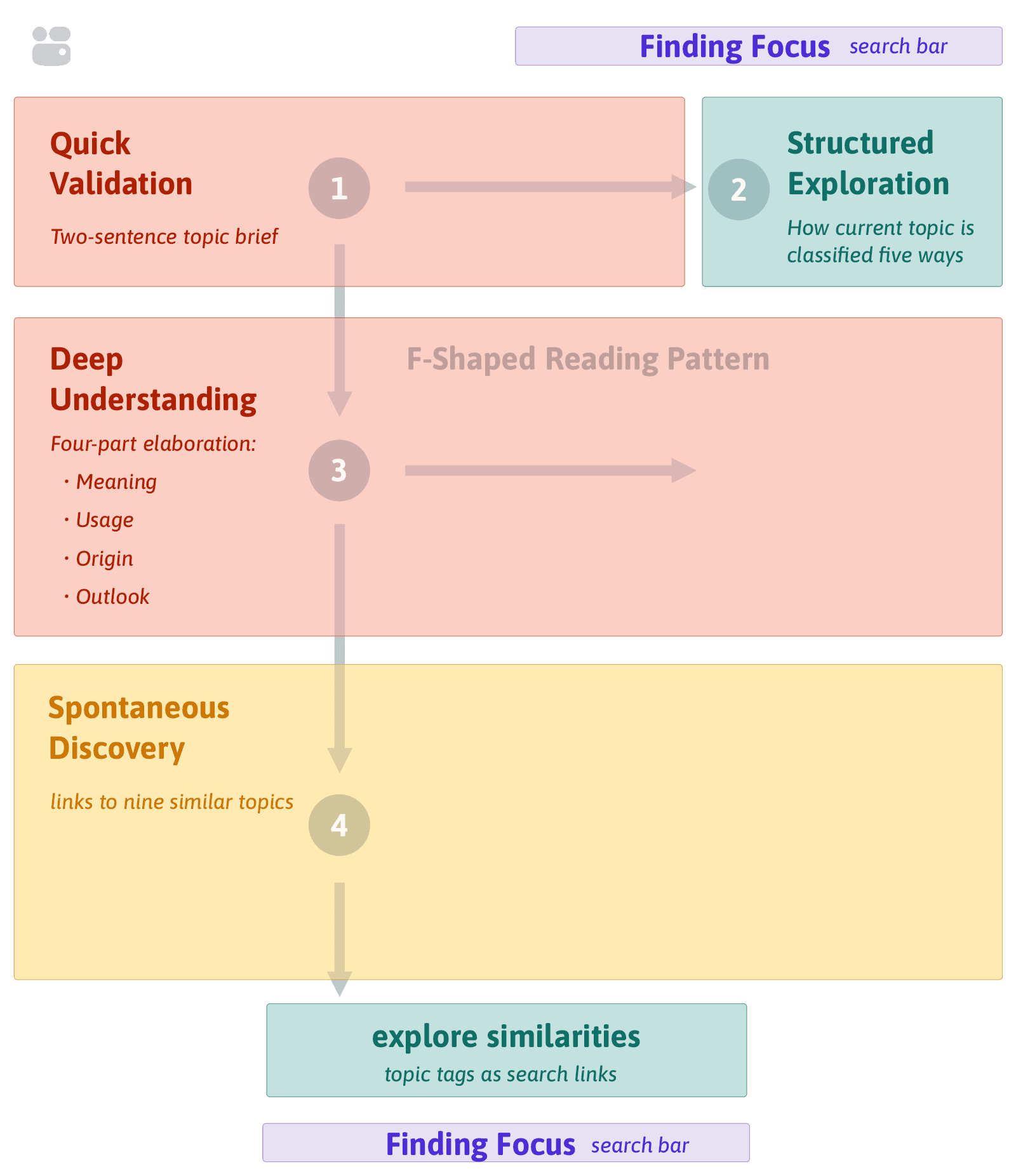
Illustrating how the design targets and supports four distinct modes of knowledge exploration—from initial search through discovery of related concepts.
Architecture in Detail
Each topic page supports five distinct ways of engaging with content on Rockturn, aligned with how people naturally seek and engage information:
Finding Focus
Search appears in two strategic locations—the conventional top-right corner and again at the bottom of each page. The bottom placement includes AI-generated topic-specific suggestions to help users who know what they're looking for but may not have the exact terminology. This same pattern appears on the homepage, but with common product design terms instead of topic-specific suggestions.
Quick Validation
Each topic opens with a carefully structured two-sentence brief—first defining what it is, then explaining how it's used. This format lets users immediately confirm if they've found what they need while optimizing content for search results.
Deep Understanding
The main content follows a consistent four-part structure that guides users through meaning, usage, origin, and outlook. Each section features an SEO-optimized heading that reinforces the content's purpose while improving findability.
Structured Exploration
How the current topic is classified using facet links spanning five mutually exclusive taxonomies, providing multiple paths through the knowledge base. The cornerstone Dimension taxonomy offers a unique lens, viewing design as a spectrum from attracting users to transforming products. Each classification becomes an active exploration tool, letting users discover related concepts through different contexts.
Spontaneous Discovery
Every page ends with multiple paths forward—nine related topics, AI-generated search suggestions, and a persistent search bar. This ensures users never hit a dead end in their learning journey.
Designing for Discovery
The interface goes beyond simple information retrieval. By converting the AI-generated topic tags into search links, every page creates multiple pathways for exploration. These aren't just related topics—they're conceptual "hooks" that align with how users might naturally think about and search for information.
The goal isn't just to help users find what they're looking for, but to help them discover what they didn't know they needed to learn.
This approach creates a knowledge network that can be explored in multiple ways:
- Systematic learning through taxonomies
- Deep dives into specific areas of interest
- Organic exploration through related concepts
Taxonomy
The five taxonomies that organize Rockturn's knowledge base are more than just classification systems—they're pathfinding tools that help designers see connections and build deeper understanding.
Dimension
Domain
Utility
Level
Recency
Each carefully crafted taxonomy offers a different lens for viewing design knowledge, creating a multi-dimensional map that designers can use to chart their growth. Together, these taxonomies serve multiple strategic purposes:
- Help designers see themselves in the broader continuum of product development
- Reveal unexpected connections between seemingly unrelated concepts
- Create natural learning paths from foundational to advanced topics
- Show how design knowledge evolves and adapts over time
- Bridge gaps between design craft and business strategy
Dimension Taxonomy

Dimensions are the cornerstone of Rockturn's compendium, outlining the nature of design problem-solving at each successive stage of product development.
Rockturn's Dimension taxonomy exemplifies how classification can drive deeper understanding. By viewing design through five distinct facets—Attract, Influence, Enable, Deliver, and Transform—it helps designers see beyond traditional craft boundaries. This framework reveals how design shapes outcomes at every stage of product development, from initial user engagement through long-term innovation.
Attract — Market Presence & Brand Affinity…
Topics oriented around market presence and brand affinity, driving outcomes by capturing user attention and creating memorable first impressions, while balancing brand consistency with appeal to diverse user preferences.
Challenges for design in this dimension include:
- Standing out visually in a competitive landscape, managing cognitive biases that influence perception, and ensuring the design resonates with different audience segments
- Navigating cultural and aesthetic differences, accessibility needs, and the risk of visual clutter that can overwhelm users
- Balancing of striking visuals, clear branding, and a streamlined user experience that invites engagement without sacrificing clarity
Influence— Revenue & Growth…
Topics oriented around revenue generation and market share, driving outcomes by understanding and shaping user behavior, identifying motivations, minimizing friction, and promoting actions aligned with company values and business goals.
Challenges for design in this dimension include:
- Decoding user decision-making processes and mitigating points of hesitation
- Crafting subtle cues that nudge users navigating choice architectures
- Balancing persuasive design with ethical considerations
Enable— Design Maturity at Scale…
Topics oriented around design maturity at scale, driving outcomes by building efficient systems and workflows that enable high-performing and collaborative product teams—which translates to high production quality and brand consistency.
Challenges for design in this dimension include:
- Managing the consistency, scalability and integration of design systems
- Coordinating design processes and standards across functional areas
- Orchestrating design workflows to enhance confidence and productivity
Deliver— Customer Retention & Loyalty…
Topics oriented around customer retention and loyalty, driving outcomes by maintaining high standards for reliability, performance, and user satisfaction through continuous product enhancements and performance improvements.
Challenges for design in this dimension include:
- Meeting user expectations for seamless product operation and performance
- Balancing technical and design debt with immediate business demands
- Addressing structural improvements essential for long-term stability
Transform— Product-Market Fit…
Topics oriented around competitiveness and product-market fit, driving outcomes by staying ahead of trends and promoting a founder’s mindset towards innovation and market leadership.
Challenges for design in this dimension include:
- Identifying and evaluating emerging technologies, forecasting trends, and anticipating future user needs
- Fostering a culture of experimentation that aligns innovation with core product values and business goals
- Responding proactively to shifts in the competitive landscape, balancing visionary updates and practical enhancements
Domain Taxonomy
Sorts topics by intersecting fields of knowledge, demonstrating the cross-functional nature of aligning product design with broader objectives and outcomes.
Six Domain Facets…
Business
Focuses on broader business operations, strategy, and efficiency. This includes product management, business strategy, financial considerations, and organizational behavior, ensuring that product design aligns with business goals and drives organizational success.
Design
Focuses on tools, processes, principles, and metrics related to creating user experiences and interfaces. This domain encompasses everything from visual design to user interaction and usability testing, ensuring that the end product is both functional and aesthetically pleasing.
Engineering
Covers the integration of development and operational practices necessary for the software lifecycle. This includes software engineering principles, systems architecture, DevOps, and technical implementation, ensuring robust, scalable, and maintainable products.
Marketing
Addresses concepts related to brand, marketing strategies, and sales that drive user engagement and growth. This domain involves understanding market dynamics, user acquisition, and retention strategies to ensure that products reach and resonate with their intended audience.
Psychology
Studies human cognition, perception, and behavior to influence design decisions. This domain includes cognitive psychology, behavioral economics, and user psychology, providing insights into how users interact with products and how to design for optimal user experiences.
Research
Encompasses methodologies and practices for competitive, market, and user research. This domain includes qualitative and quantitative research techniques to gather insights that inform strategic decisions and user-centered design processes.
Level Taxonomy
Classifies concepts based on complexity and experience required to master them. It aids designers in identifying foundational knowledge, intermediate concepts, advanced techniques, and specialized skills, offering a roadmap for professional growth and depth of understanding in various aspects of design.
Three Level Facets…
Foundational
Core concepts that form the essential building blocks of design knowledge, providing the baseline understanding needed to work effectively in digital product design. These are the fundamental principles, methods, and skills that every designer should master, regardless of their specialization or career stage.
Intermediate
More complex topics that build upon foundational knowledge, requiring some professional experience to fully grasp and apply effectively. Intermediate level concepts often involve combining multiple principles or adapting standard approaches to handle more nuanced challenges in product design.
Advanced
Sophisticated concepts and strategies that demand significant experience and expertise to implement successfully in complex product environments. Advanced techniques often involve systems thinking, strategic decision-making, and the ability to navigate ambiguous problem spaces while balancing multiple stakeholder needs.
Utility Taxonomy
Organizes concepts according to their practical application and value in solving business problems. It spans high-level strategic roles, methods, and principles, down to the tactical and technical skills and tools necessary for achieving high quality design outcomes, as well as theoretical insights and cautionary considerations for ethical and effective design practices.
Six Utility Facets…
Analytical
Tools and methods for measuring, evaluating, and optimizing the business impact of design decisions through data-driven insights. Analytical techniques help teams understand user behavior, track performance metrics, and make informed decisions about how to improve products and services.
Cautionary
Concepts, practices, and patterns that can lead to poor outcomes if not carefully considered or properly implemented in design work. Cautionary topics highlight potential pitfalls, ethical concerns, and unintended consequences that designers should actively work to avoid.
Strategic
Methods and frameworks that connect design decisions to measurable business outcomes, helping teams plan and execute solutions that drive long-term success. Strategic concepts focus on aligning design with organizational goals, market opportunities, and customer needs through systematic approaches to problem-solving.
Tactical
Practical techniques and proven methods that designers use daily to create high-quality solutions and improve user experiences. Tactical hands-on skills and standards help teams execute effectively, maintain consistency, and deliver polished design work that meets or exceeds expectations.
Technical
The tools, platforms, and technologies that enable teams to create, prototype, test, and implement design solutions effectively. Technical topics involve both fundamental technologies that form the foundation of digital product design and emerging tools that expand what’s possible in modern design work.
Theoretical
Core principles from psychology, sociology, and other disciplines that explain how people think, behave, and interact with design. Theoretical concepts help designers understand the “why” behind successful design patterns and inform more thoughtful, human-centered solutions.
Recency Taxonomy
Organizes concepts by their historical emergence, highlighting the evolution of design practices over time. It helps designers understand the impact of technological advancements and historical context on current design methodologies, ranging from the pre-computing era to the latest developments in AI and machine learning.
Five Recency Facets…
AI & Machine Learning (After 2015)
Concepts that emerged with the rise of artificial intelligence, machine learning, and advanced analytics in design and product development. These topics reflect how automation and AI are reshaping design processes, tools, and possibilities.
Mobile & Social Media (2005-2015)
Topics that gained prominence during the mobile revolution and the rise of social platforms, fundamentally changing how people interact with digital products. These concepts capture the shift toward responsive design, app-first thinking, and the integration of social features into product experiences.
Internet Expansion (1990-2005)
Principles and methods that evolved during the global expansion of the internet and the emergence of web design as a discipline. These topics represent the foundation of digital design, including core concepts about usability, accessibility, and user experience that still shape design thinking today.
Early Computing (1950-1990)
Concepts from the early days of digital technology, when the fundamental principles of human-computer interaction were first being explored. These topics include essential theories about how people interact with machines and early frameworks that continue to influence modern design.
Pre-Computing (Before 1950)
Traditional design principles from psychology, art, mathematics, and other fields that predate digital technology but remain relevant to modern product design. These foundational theories about human perception, behavior, and aesthetics provide timeless insights that inform effective design regardless of medium or technology.
Turning Theory into Practice
While these taxonomies create a robust framework for organizing and discovering knowledge, transforming this vision into a working platform required careful attention to implementation details. Every classification, connection, and navigation path needed to be not just theoretically sound, but practically useful. The challenge ahead was ensuring that this carefully constructed knowledge architecture would translate into an intuitive, engaging user experience.
Delivery
Bringing Rockturn to life meant translating months of content development and taxonomic architecture into a working platform. I chose WordPress for its extensibility and content management capabilities, but making it serve as a knowledge engine required careful implementation.
From Excel to Platform
The Excel prototype that had served as my testing ground for content relationships now needed to become a dynamic web experience. This involved:
- Porting structured content a into web-enabled database
- Programming taxonomy systems as navigational facets
- Enabling algorithmic, networked topic relationships
- Search functionality that leveraged tags as query parameters
Quality Control at Scale
With over 1,500 topics, each with multiple taxonomic classifications and AI-generated content, quality assurance had to be iterative, continuous, and rigorous. My approach was systematic:
Content Review
- Consistency of topic definitions
- Accuracy of four-part expositions
- Logical flow between sections
- SEO optimization of headings
Classification Verification
- Proper taxonomy assignments
- Meaningful relationships between topics
- Intuitive navigation paths
- Working search functionality
User Experience Design
- Pathfinding discovery flows
- Clear information hierarchy
- Meaningful search suggestions
- Mobile responsiveness
Building Discovery Paths
The final challenge was ensuring that all the interconnections between topics worked as intended.
A topic page on Rockturn is not just a container for organizing content—it's a pathfinding tool for exploring knowledge.
Every taxonomy classification, related topic link, and search suggestion needed to create meaningful paths for exploration. This meant testing:
- Cross-linking between related topics
- Taxonomy-based navigation
- Search suggestion relevance
- Tag-based discovery paths
Through careful implementation and rigorous testing, Rockturn evolved from an ambitious vision into a working knowledge engine. But the true test would lie in how well it served its purpose: helping designers navigate the changing landscape of their profession with both confidence and competence. The platform's impact would be measured not just in its comprehensive content, but in how effectively it helped designers transform from craftspeople focused on outputs to strategic leaders driving outcomes.
Leading Through Action
Rockturn represents more than just a knowledge platform—it's a proof of concept for the Surfist mindset. By using AI as a force multiplier to create something that would have been impossible through traditional means, I demonstrated the very approach I'm advocating for designers.
Humility
Willingness to rethink my approach to such an ambitious project
Curiosity
Exploring how AI could enhance rather than replace human creativity
Creativity
Finding innovative ways to develop content and connections at scale
Confidence
Built through systematic problem-solving and tangible results
By using AI as a collaborator rather than a replacement, we can achieve things that neither humans nor machines could do alone.
Beyond Content Creation
The project shows how designers can approach AI strategically:
- Break down complex challenges into manageable pieces
- Use AI to handle repetitive tasks while maintaining creative control
- Focus human effort on vision, quality, and user experience
- Create systems that scale without losing human insight
A Platform for Growth
In six months, Rockturn grew from concept to comprehensive resource:
- 1,500+ carefully curated topics
- Five interconnected taxonomies
- Thousands of discovery paths
- A philosophy for navigating change
As AI continues to reshape the design landscape, Rockturn stands ready to evolve alongside it. The platform's dual focus on mindset and knowledge provides a foundation for continuous growth, helping designers transform from creators of artifacts to shapers of outcomes.
Like a surfer reading the ocean, tomorrow's designers need to understand the forces shaping their field. Rockturn helps them develop both the knowledge to see these patterns and the confidence to ride them—turning technological disruption into opportunity for growth.
More case studies
Short case studies in design leadership demonstrating the range of impacts I have had over more than two decades in the field.
A framework for matching talent to impact, where aligning temperament with task drives confidence and performance.
Using everyday metaphors to elevate teams—explore how I build shared understanding around quality and excellence.
From silos to synergy—how I unified 50+ product teams under a shared experience vision that drove loyalty and growth.
A case of community impact at scale—follow how I architected a digital strategy for economic mobility in Charlotte.

Rockturn is a knowledgebase for digital product design. Find your next wave.
search suggestions
Dive right in!