Case Study
Five Dimensional Design™
After more than a decade building and leading design teams, I turned what I had learned about designer temperaments into a framework for talent-product fit, matching individual contributors with stages of product design work that align with their ambitions, not just their talents.
Designers are more confident and engaged when the nature of their work is aligned with their natural temperament and ambition.
Complication
Different stages of product development demand distinct temperaments, yet designers may struggle to find their ideal fit.
Resolution
I developed Five Dimensional Design, a framework that aligns designers with distinct problem-solving demands in product development.
Outcome
The framework provides design leaders with a systematic approach to building teams where individual strengths drive collective impact.
This case study follows my process of developing the Five Dimensional Design framework, from its origins rooted in observation and experience to the rigors of scrutinizing every aspect to ensure its utility. Each section captures a distinct phase of transforming experiential insight into systematic practice.
Process:

AI audio overview (11 minutes)
Listen to a deep dive on this case study from Google's NotebookLM
Observe
Design talent is like athleticism
When we think of design leadership, we often focus first on vision—the ability to imagine and articulate bold creative directions. But true design leadership means nurturing talent as much as it means shaping outcomes.
Product design is a team sport, like baseball—where every player can run, throw, catch, and hit, but excels differently across these fundamentals. The best pitcher might be the worst hitter. The best catcher might be the slowest runner. What makes a player an ideal pitcher base might make them less effective at shortstop, just a few feet away. It’s nuanced. Design is just like this. But we need to go a bit deeper on the analogy to understand what this framework is about. It’s not about talent (or athleticism in baseball). It's about love of the game and desire to win.
In this analogy, “design dimensions,” as I call them, aren’t the positions on a baseball field; they’re the sport. There’s a ball, a set of rules, and certain strategies for winning. There’s offense and defense, and a way of keeping score. None of this is unique to baseball; it's often the same in other sports—basketball, football, rugby, soccer, tennis—polo, even. My point is professional athletes excel at the sport they've studied, practiced, and know how to win. Despite their athleticism, they're not interchangeable between sports any more than designers are interchangeable between dimensions (ever seen an NBA all-star power forward swing a golf club?). We’ll get to what these dimensions are in just a moment, but it’s essential to understand why I sought to define them in the first place.
As a leader, developing people’s potential is an important part of the job—an aspect of good judgment that helps us (the business) win as a team. Aligning individuals with work that merely leverages their talent is not a winning strategy. It doesn’t account for instincts or interest in certain kinds of problem-solving. It doesn’t address important questions like:
- Which ‘sport’ of problem-solving do they want to be better at?
- Which do they have a knack for strategizing and know how to win?
- Are they more curious about how to attract customers, or how to keep them?
- Under pressure, is their instinct to theorize, organize, or analyze?
- Do they have a more intuitive grasp of marketing, technology, or business?
- Do they believe the problems they are being asked to solve are important?
- Do they understand why, or are they just doing what’s necessary to keep their job?
These are all critical factors in product design as a sport at the major league level. That’s what this framework is about.
Understand
Risks of not aligning work with purpose
When designers work in areas that spark their curiosity, learning feels effortless, creativity expands, and confidence builds naturally. This alignment is not just a matter of job satisfaction; it is essential for professional development and team performance. I've seen the consequences of misalignment. It leads to serious struggle. Performance plateaus, morale dips, and a lack of emotional safety emerges, limiting the risk-taking and exploration essential to creativity.
Impacts are deep and long-lasting:
A downward spiral of diminishing confidence takes hold as designers lose their sense of purpose and connection to the work.
Team members withdraw from collaboration and resist new challenges, seeing them as disruptions instead of opportunities for growth.
Designs become mechanical and prescribed, focused on meeting bare minimum requirements rather than pushing boundaries.
On the other hand, when a designer is problem-solving within a phase of product development that aligns with their inclinations—not just their talent—they are more energized to understand the problem space, more imaginative about potential solutions, and more discerning towards driving business outcomes. This alignment is not about catering to personal interests but recognizing which sport they can play to win. A well-placed and engaged designer is a winner—a thought leader, innovator, and role model. You can never have enough of those on your team.
This realization took root more than a decade ago during my time leading design at Ally. The strongest design work consistently came from those whose work assignments aligned not just with their capabilities but with their instinct to understand the problem space.
Unlocking individual potential requires a deep understanding of each designer's innate problem-solving instincts.
Conceptualize
How confidence derives from humility
That insight about instincts led me to explore how curiosity fuels creativity and, ultimately, professional confidence. I've theorized about this dynamic in a cycle of growth model (Figure 1) which illustrates how curiosity, creativity, and confidence derive from humility. (For a deeper dive on this, see what I've written about humility on Rockturn as an alternative to pride and imposter syndrome.)
Cycle of growth:
- Humility unlocks curiosity.
- Curiosity fuels learning and creative exploration.
- Creativity, when applied with purpose, builds lasting confidence.
These elements form a virtuous cycle where humility keeps the ego in check, curiosity expands the knowledge base, and creativity turns insight into impact—fueling self confidence. When supported in the right work context, this cycle drives both personal growth and better design outcomes.
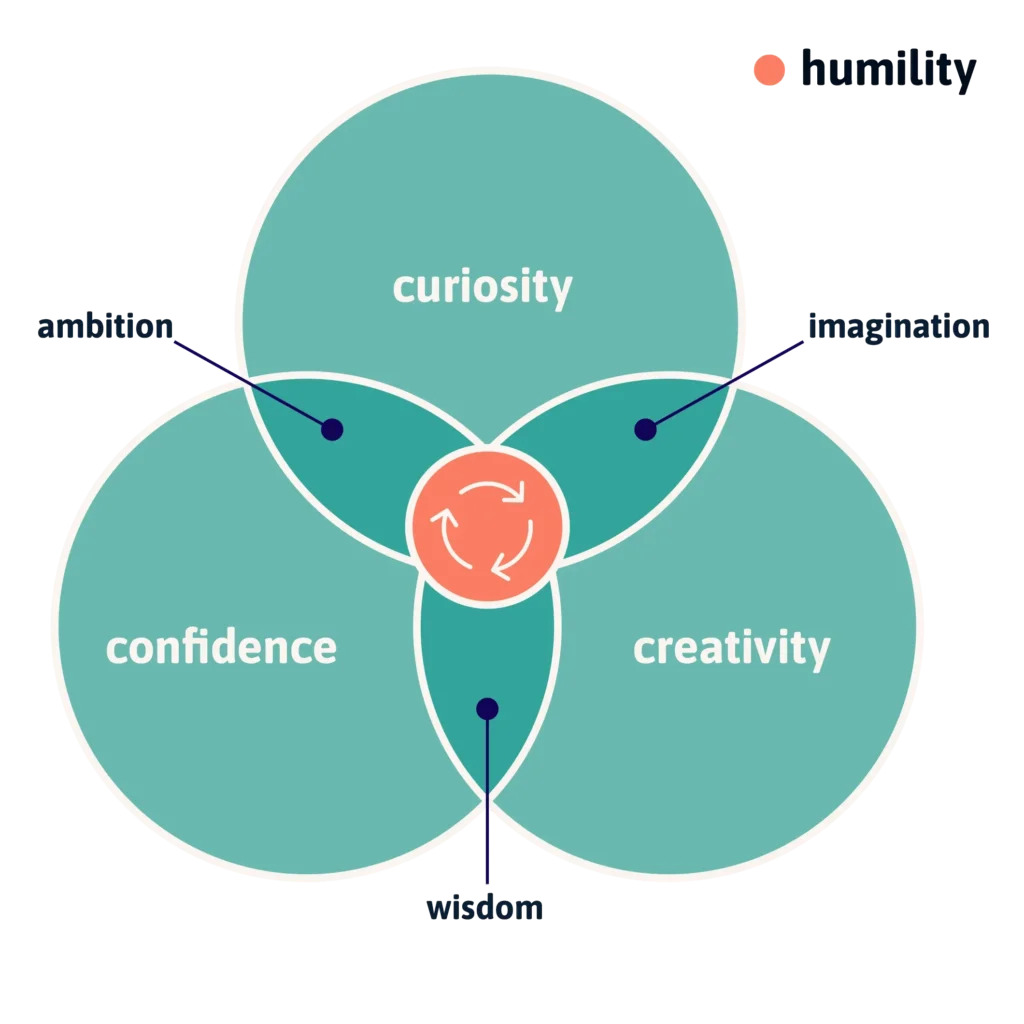
Originally developed for Rockturn, this model explores how purposeful humility can unlock professional growth through curiosity-driven learning and confidence building.
This theoretical foundation—recognizing how natural curiosity and creative strengths influence performance—shaped my thinking around what would become the Five Dimensional Design model, the cornerstone taxonomy of my Rockturn compendium.
Refine
Organizing insights into actionable dimensions
With clear patterns emerging from years of building and leading design teams, I needed a framework that could map individual affinities to the phases of product development where designers naturally excelled. I had long used an informal list of ten design affinities—captivate, inform, persuade, visualize, signify, adapt, facilitate, lead, affirm, and synthesize—to help me make better management decisions by recognizing how each designer's natural inclinations would emerge as strong opinions in some contexts but not others.
While effective for one-on-one talent development, this back-pocket framework proved too nuanced for broader application. The challenge was to frame these hard-won insights into a model that could systematically align intrinsic motivation with business impact. Through careful refinement, I distilled what I understood as ten affinities into five core dimensions (Figure 2) that could guide both personal development and strategic team alignment: Attract, Influence, Enable, Deliver, and Transform.
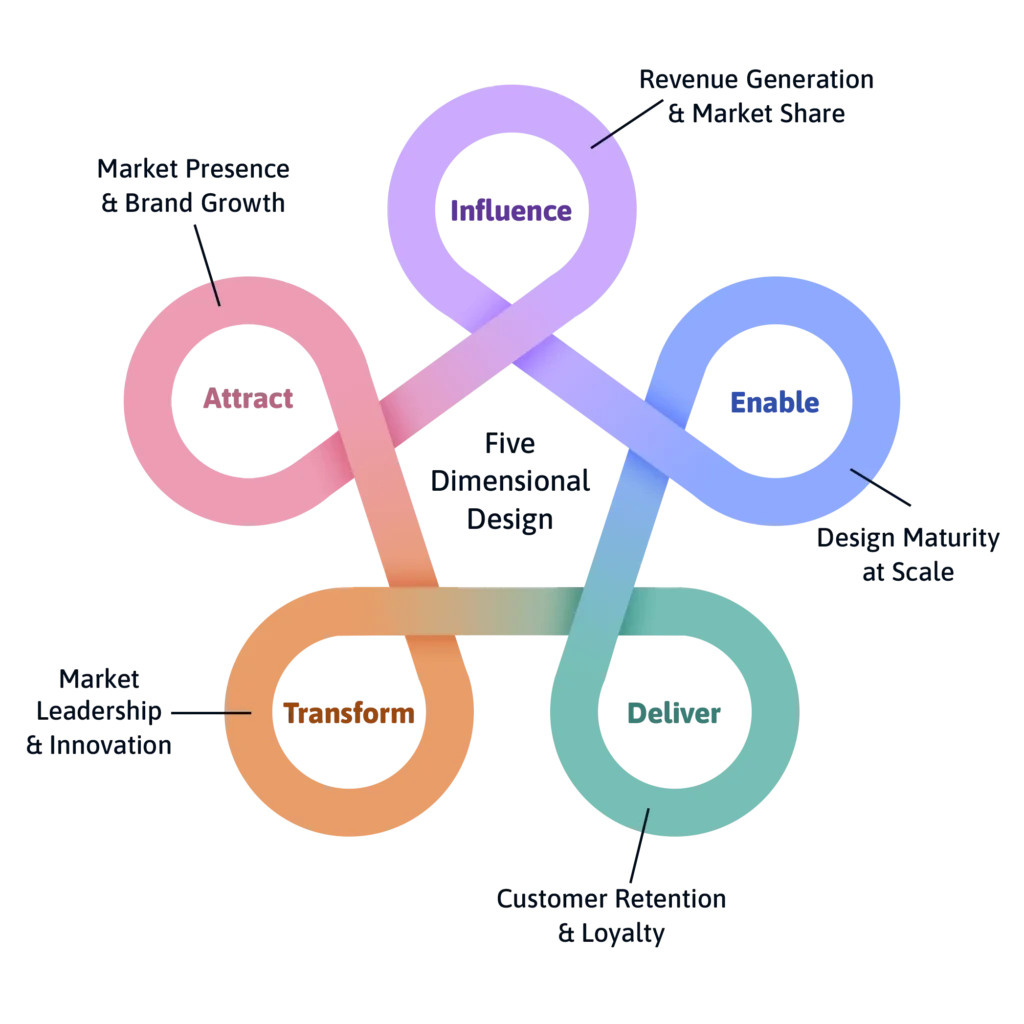
A conceptual framing of the five core design dimensions. Each dimension represents a distinct problem space where designers can excel when aligned with their natural strengths and interests.
The success of this framing hinged on finding the sweet spot between simplicity and depth—a structure simple enough to be memorable yet nuanced enough to capture the complexity of how different individuals are naturally driven to solve different types of problems. By mapping these dimensions to distinct stages of product development, the framework could help both individuals and organizations identify where designers would be most energized to drive impact.
Ground
Applying the rigors of real-world contexts
The Five Design Dimensions offer a structured way to understand how different designers contribute across phases of product development—but a framework built on observation alone isn't enough. To ground these dimensions in practice, we need to understand both what drives sustained engagement and how that engagement translates to meaningful outcomes. Each dimension reflects not just a creative approach, but a distinct way designers stay energized and focused when aligned with work that resonates with their natural problem-solving instincts.

Mapping dimensions to typical challenges, performance indicators, and ideal temperaments.
Attract: Market Presence & Brand Affinity
Oriented around market presence and brand affinity, driving outcomes by capturing user attention and creating memorable first impressions, while balancing brand consistency with appeal to diverse user preferences.
Challenges
- Standing out visually in a competitive landscape, managing cognitive biases that influence perception, and ensuring the design resonates with different audience segments
- Navigating cultural and aesthetic differences, accessibility needs, and the risk of visual clutter that can overwhelm users
- Balancing of striking visuals, clear branding, and a streamlined user experience that invites engagement without sacrificing clarity
Indicators
- High return on advertising spend
- High click-through & open rate
- Brand affinity, awareness & recall
- Positive brand sentiment
- Social media engagement & sharing
- Campaign virality
Temperament
- Strong aesthetic sense and emotional design instincts
- Intuitive awareness of trends and pop culture
- Talent for compelling visual storytelling that creates emotional connections
Influence: Revenue & Growth
Topics oriented around revenue generation and market share, driving outcomes by understanding and shaping user behavior, identifying motivations, minimizing friction, and promoting actions aligned with company values and business goals.
Challenges
- Decoding user decision-making processes and mitigating points of hesitation
- Crafting subtle cues that nudge users navigating choice architectures
- Balancing persuasive design with ethical considerations
Indicators
- Conversion, completion & activation optimization
- Bounce rate & abandonment reduction
- Reduced friction & time on task
- Increased cross-sell & upsell
- Product & feature adoption
Temperament
- Strategic thinking with a keen sense of human behavior
- Shrewd analysis of user motivations to predict what drives meaningful engagement
- Competitive spirit with a results-driven approach to experience design
Enable: Design Maturity at Scale
Topics oriented around design maturity at scale, driving outcomes by building efficient systems and workflows that enable high-performing and collaborative product teams—which translates to high production quality and brand consistency.
Challenges
- Managing the consistency, scalability and integration of design systems
- Coordinating design processes and standards across functional areas
- Orchestrating design workflows to enhance confidence and productivity
Indicators
- Speed-to-market
- Design maturity
- Brand & UX consistency
- Workflow efficiency & productivity
- Team performance & engagement
- Minimal rework & technical debt
- Stakeholder confidence & cross-functional collaboration
- Usability, accessibility & self-service maximization
Temperament
- Systematic, methodical, and detail-oriented with an instinct for orchestrating efficiency
- Vision to achitect and build standardized frameworks that transform team collaboration
- Expert in design systems, development processes, and operational efficiency
Deliver: Customer Retention & Loyalty
Topics oriented around customer retention and loyalty, driving outcomes by maintaining high standards for reliability, performance, and user satisfaction through continuous product enhancements and performance improvements.
Challenges
- Meeting user expectations for seamless product operation and performance
- Balancing technical and design debt with immediate business demands
- Addressing structural improvements essential for long-term stability
Indicators
- Product adoption & organic growth
- Continuous product improvement
- Minimal time to value & churn rate
- Maximum daily/monthly active users
- Customer loyalty & retention
- High NPS & top two box CSAT
Temperament
- Committed team player with lasting focus on excellence and long-term impact
- Balances technical constraints, user needs, and quality standards
- Collaborative and dedicated to incrementally perfecting user experiences
Transform: Product-Market Fit
Topics oriented around competitiveness and product-market fit, driving outcomes by staying ahead of trends and promoting a founder’s mindset towards innovation and market leadership.
Challenges
- Identifying and evaluating emerging technologies, forecasting trends, and anticipating future user needs
- Fostering a culture of experimentation that aligns innovation with core product values and business goals
- Responding proactively to shifts in the competitive landscape, balancing visionary updates and practical enhancements
Indicators
- Product-market fit
- Market category creation
- First-mover advantage
- Patent/IP generation
- High velocity feature adoption
- Competitive differentiation
- Digital transformation
Temperament
- Embraces complexity with a founder’s mindset, driven to improve what others accept as fixed
- Thrives in uncertainty, trusting research and persistence to navigate high-risk problem spaces
- Balances deep expertise with imagination, blending structure with improvisation
With these five dimensions as the foundation, a solid framework could be built. Next, I scrutinized how each dimension drives different types of outcomes through different modes of thinking. This led me to conduct a deeper analysis to define more mutually exclusive, collectively exhaustive (MECE) differentiating criteria.
Validate
Ensuring reliability and alignment with goals
To validate the utility of these dimensions—to go from theory to practice—I thoroughly analyzed them through a MECE lens. I began the process by outlining all the unique perspectives that influence design—from strategic goals and problem spaces to emotional responses and philosophical intent. I examined how each dimension is uniquely framed by business (objectives, functions, processes) on one hand, as well as people (users, collaborators, stakeholders) on the other. This comprehensive analysis generated nearly 30 differentiating facets across the five dimensions, validating both the independence and completeness of each one.
The following matrix distills these insights into seven key differentiators, demonstrating how each dimension serves distinct needs while fitting into a complete framework for product development. This systematic validation laid the groundwork for practical implementation through detailed blueprints, ensuring the framework could effectively guide both individual contributions and team dynamics.
Attract |
Influence |
Enable |
Deliver |
Transform |
|
|---|---|---|---|---|---|
| Purpose & Impact |
Impressions
Capturing attention and driving engagement |
Conversions
Turning prospects into customers |
Performance
People, processes, and systems for growth |
Retention
Encouraging repeat engagement and use |
Adoption
Driving innovation and product-market fit |
| Design Philosophy |
Show the Way
Creating compelling first impressions |
Lead the Way
Guiding users to valued outcomes |
Clear the Way
Removing friction and complexity |
Make the Way
Building reliable, lasting experiences |
Improve the Way
Advancing product possibilities |
| Problem Space |
Brand Narrative
Forming impressions and expectations |
Value Proposition
Illustrating benefits and overcoming objections |
Service Experience
Managing complexity and upholding integrity |
Product Performance
Validating reliability and commitment |
Market Potential
Incubating progress and future success |
| Creative Temperament |
Artistic
Culturally attuned with aesthetic sensibilities |
Strategic
Data-driven with deep behavioral insights |
Systematic
Process-oriented with operational excellence |
Persistent
Detail-focused with quality standards |
Visionary
Future-focused with connecting insights |
| Psychological Drivers |
Interest
Sparking curiosity and emotional connection |
Motivation
Building desire and encouraging action |
Confidence
Creating trust through consistency and clarity |
Satisfaction
Reinforcing value with reliable experiences |
Aspiration
Inspiring growth and future possibilities |
| Business Outcome |
Market Voice
Building brand presence and resonance |
Revenue Growth
Increasing acquisition and sales |
Operational Scale
Improving efficiency and consistency |
Customer Value
Deepening engagement and loyalty |
Market Position
Advancing competitive advantage |
| Success Metrics |
Engagement
Brand awareness and interaction rates |
Conversion
Task completion and adoption metrics |
Efficiency
System performance and team productivity |
Reliability
Uptime and customer satisfaction scores |
Innovation
Feature adoption and market feedback |
Blueprint
Aligning with practical, high-impact outcomes
The blueprint approach transforms abstract dimensions into actionable guidance for product teams. Each blueprint clarifies how different roles—from designers and researchers to engineers and product managers—contribute to success within that dimension.
The Influence Blueprint, provided below as an example, demonstrates this practical application. It breaks down the dimension's purpose, problem space, success metrics, and role-specific responsibilities. This level of detail helps teams understand not just what needs to be done, but how different functions collaborate to achieve results.
Similar blueprints exist for each dimension, providing a consistent framework for talent development and strategic planning. Together, they offer a structured approach to building high-performing product teams where design can drive meaningful business impact.

Influence Blueprint
Influence is centered on guiding user behavior, decision-making, and engagement through thoughtful application of behavioral psychology and motivational principles. The goal is to subtly shape user actions and increase conversion by creating clear, persuasive pathways toward desired outcomes. Influence leverages a deep understanding of user motivations, decision triggers, and psychological cues to foster engagement, satisfaction, and loyalty in a way that feels seamless and unobtrusive to users.
Framework Elements
Problem Space
The Influence problem space centers on understanding and shaping user behavior by identifying motivations, minimizing friction, and promoting actions aligned with product goals. Challenges include decoding user decision-making processes, mitigating potential points of hesitation, and crafting subtle cues that encourage specific actions without feeling manipulative. Teams must address varying levels of user engagement and ensure that motivational design elements work across different contexts and user mindsets. Balancing persuasive design with ethical considerations (e.g., avoidance of dark patterns) is essential to success in this dimension.
Strategies
The Influence dimension relies on crafting experiences that gently persuade users to take desired actions. This involves understanding user motivations, addressing potential hesitation, and designing intuitive choice architectures. Reducing friction through clear workflows, leveraging behavioral cues like urgency signals, and fine-tuning persuasive elements through testing are critical approaches. By aligning user goals with business outcomes, these strategies create a supportive environment for confident decision-making.
Tactics
Influence tactics prioritize immediate decision-making by guiding users toward desired outcomes with minimal friction. Tools like micro-interactions, visual hierarchy, and behavioral nudges are designed to reduce cognitive load and encourage action. For example, clear call-to-action buttons and contextual prompts help streamline the user journey by addressing concerns in real time. These tactics support users in progressing seamlessly toward their goals.
Temperament
Individuals drawn to the Influence dimension are insightful, strategic, and often carry a competitive edge, driven by the challenge of shaping user behavior to achieve meaningful engagement and decisive action. Their natural curiosity about what motivates people is paired with a desire to see results, fueling an iterative approach where they refine and optimize experiences to meet and surpass benchmarks. With a keen eye for behavioral patterns and decision triggers, they channel their competitive spirit into creating persuasive design elements that guide users seamlessly toward desired actions. This mix of analytical thinking, empathy, and strategic competitiveness makes them adept at crafting experiences that align user behavior with product goals, often setting new standards for user engagement.
Quantitative Metrics
Influence effectiveness is measured by tracking how effectively the product drives user actions and motivates immediate decisions. Metrics focus on conversion rates, task completion percentages, bounce rate reductions, and cross-sell or upsell activity. Analyzing user behavior within decision-making paths, such as checkout flows or onboarding journeys, reveals friction points and opportunities for improvement. These insights reflect how well the product encourages users to take specific, meaningful actions aligned with business objectives.
Qualitative Insights
Qualitative insights focus on understanding user motivations, decision-making processes, and behavioral responses to design cues. Through interviews, usability testing, and behavioral studies, insights are gained into how effectively the product guides actions, persuades, or motivates users. Observations of user interactions across key tasks help reveal pain points or moments of hesitation, while in-depth feedback can clarify the factors that influence a user’s willingness to take specific actions. This understanding allows the team to refine behavioral cues and optimize user journeys to better align with users’ intrinsic motivations.
Team Perspective
Designer's Role
Uses informed judgment to guide users through the product in a way that feels natural and motivating. They strategically design calls to action, progress indicators, and subtle visual cues that encourage users to take desired actions. Informed by metrics, direct observation, principles of user psychology and insights from behavioral science, they ensure that design elements foster engagement and reduce friction, adapting layouts and interactions based on feedback to create a journey that aligns with user motivations and product goals.
Product Manager
Defines features that encourage desired behaviors by working closely with designers and data analysts to create clear, goal-oriented user journeys, strategically placing calls to action and motivational cues. This role involves continuously testing and refining engagement strategies based on user behavior insights, optimizing the product experience to ensure alignment between business objectives and user needs, while maintaining an ethical approach to behavior-guiding design.
Data Analyst
Data Analysts in the Influence dimension focus on uncovering patterns and trends that reveal how users interact with the product. They identify critical points of decision-making, measure the effectiveness of persuasive elements, and track user behavior through conversion funnels. Their work enables the optimization of user flows, reduces friction, and provides actionable insights for improving conversion rates and feature adoption. By transforming raw data into targeted strategies, Data Analysts play a pivotal role in driving meaningful user actions aligned with business goals.
Researcher
Analyzes user motivations, decision-making processes, and behavior patterns to guide engagement strategies. They conduct behavioral research on the usability of systems and interfaces to uncover the factors that drive users to take specific actions, identifying opportunities for persuasive design elements such as calls to action, motivational cues, and feedback loops. By testing different journey flows and gathering feedback on interaction points, they help refine the product experience, ensuring that design elements effectively guide users in a way that feels intuitive and rewarding.
Marketer
Crafts compelling narratives that reinforce the brand, resonate with user motivations, and encourage immediate action. Their focus is on emphasizing the product’s value proposition through emotionally compelling and logically persuasive messaging, designed to align with behavioral insights. By analyzing user behaviors and identifying hesitation points, marketers refine strategies and messaging to reduce friction and maximize conversions. The ultimate goal is to balance compelling persuasion with ethical integrity, ensuring trust while achieving measurable outcomes.
Engineer
Implements the backend and frontend elements that drive user behavior and engagement. They support behavioral design by coding interactive components like prompts, notifications, and progression indicators that encourage users to explore and complete key actions. They work with designers and data teams to refine these features based on user feedback, adjusting functionality to ensure each interaction aligns with user motivations while remaining efficient and technically sound.
Wrap Up
This granular framework does more than map design talent—it creates shared understanding across product teams about how design drives business value. Each blueprint gives teams practical tools to align individual strengths with strategic needs, clarifying how different roles contribute to design excellence. By making the implicit explicit, the Five Dimensional Design model helps organizations build truly collaborative environments where designers can lead through their natural strengths. As design continues to shape how businesses compete and innovate, frameworks like this one become essential for scaling design's impact thoughtfully and systematically.
The success of any design organization ultimately depends on its ability to unleash the full creative potential of its people. By recognizing and nurturing the distinct ways designers think and create, we strengthen not just individual careers, but the broader capacity for design to transform business outcomes. This model offers a path forward—one that honors the diversity of design talent while providing the structure needed to build high-performing teams that consistently deliver meaningful impact.
More case studies
Using everyday metaphors to elevate teams—explore how I build shared understanding around quality and excellence.
From silos to synergy—how I unified 50+ product teams under a shared experience vision that drove loyalty and growth.
Short case studies in design leadership demonstrating the range of impacts I have had over more than two decades in the field.
A case of community impact at scale—follow how I architected a digital strategy for economic mobility in Charlotte.
A knowledge engine for the AI era—how I transformed theoretical frameworks into a knowledge engine for strategic growth.

Rockturn is a knowledgebase for digital product design. Find your next wave.
search suggestions
Dive right in!